
Embrace Weird | 1 Peter 1:13-2:3 Notes

The Gospel Pattern: Why God’s Grace Always Comes Before Our Obedience
There’s a profound pattern woven throughout Scripture: God’s grace always comes before our response. What God has done always precedes what we’re called to do.
In grammatical terms, indicatives come before imperatives. Indicatives are statements of fact—declarations of what is. Imperatives are commands—calls to action. And in the Bible, the order matters immensely.
This challenges our default religious instinct. Most people assume faith is fundamentally about rule-keeping—that if we do enough good and obey enough commands, perhaps God will accept us. But Christianity turns this upside down. It’s not about what we do to earn God’s favour. It’s about what God has already done for us in Christ Jesus.
The apostle Peter wrote to Christians scattered throughout Asia Minor who were learning to live as strangers in their own culture. They were “elect exiles”—God’s chosen people who no longer quite fit into their pagan world. These early Christians were weird by the standards of their society, but in the best possible way. They were different, and that difference made them irresistible.
Today, as Western culture has become increasingly post-Christian, believers find themselves in a strikingly similar situation. Being weird isn’t a problem to solve—it’s our greatest opportunity.
Hope That Changes Everything
In 1 Peter chapter 1, the first twelve verses overflow with gospel indicatives—statements about who God is, what He has done, and who we are in Christ. Then comes verse 13 with its pivotal word: “therefore.”
“Therefore, preparing your minds for action, and being sober-minded, set your hope fully on the grace that will be brought to you at the revelation of Jesus Christ.”
The old language is vivid: “gird up the loins of your mind.” The modern equivalent? “Roll up your sleeves.” Get ready to put in effort. But notice what we’re working toward: setting our hope fully on Christ.
This hope looks back to the resurrection and forward to Christ’s return. When we keep the end in view, it shapes how we live now. The question becomes: How does hope make a difference in your life?
Four Transformations of Hope
Hope Leads to Holiness. (1 Peter 1:13-16) We’re called to turn away from sin and embrace a new life—to be holy as God is holy. This isn’t about earning salvation—it’s about becoming like the One who already saved us. As we spend time in God’s presence and His word, we take on the family resemblance.
Hope Leads to Worship. (1 Peter 1:17-21)We’ve been ransomed through something of infinite value: the precious blood of Christ. Jesus, the sinless lamb, shed His blood as the ransom price. And death couldn’t hold Him—He was raised, giving us resurrection hope. The world worships money, success, comfort, youth, and pleasure. We worship a crucified Jewish carpenter who rose from the dead. It might sound weird, but it’s wonderful.
Hope Leads to Love. (1 Peter 1:22-25)Love is sincere, authentic, earnest—requiring diligent hard work. We live in an age of tribalism where people are either on our team or they’re the enemy. But the church is called to something different: authentic, self-sacrificial, cross-cultural, multi-generational love. This was the genius of the early church.
Hope Leads to Maturity. (1 Peter 2:1-3) Having tasted God’s goodness should create an appetite for more. The word of God doesn’t just save us—it grows us up. As we feed on God’s word, sin loses its power. The world says, “You do you.” Christians say, “I’m putting my sinful desires to death and craving God’s word like a newborn craves milk.”
A Story of Transformed Hope
Augustine of Hippo lived in fourth-century North Africa. His mother, Monica, was a devout Christian who spent years praying and weeping for her son night after night. But Augustine left the faith and lived a debaucherous life, enslaved to sexual addiction and the occult.
One day, Augustine heard a child singing, “Take up and read.” He grabbed a collection of New Testament writings and read Romans 13:13-14: “Let us walk properly as in the daytime, not in orgies and drunkenness, not in sexual immorality and sensuality, but put on the Lord Jesus Christ and make no provision for the flesh.”
There’s a parallel with 1 Peter 1:14: “Do not be conformed to the passions of your former ignorance, but be holy as he who called you is holy.”
Instantly, Augustine wrote, “It was as if the light of peace was poured into my heart.” His hope in Christ changed his life from utter debauchery. His hope led to holiness, worship, love, and maturity. He eventually became a bishop and one of history’s most influential Christian thinkers.
Augustine later wrote, “You’ve made us for yourself, O Lord, and our hearts are restless until they rest in you.” His changed life didn’t save him—he was saved by the wonder of Christ and His life, death, and resurrection. But once he grasped what he’d been rescued from, it led to a transformed life that helped transform others.
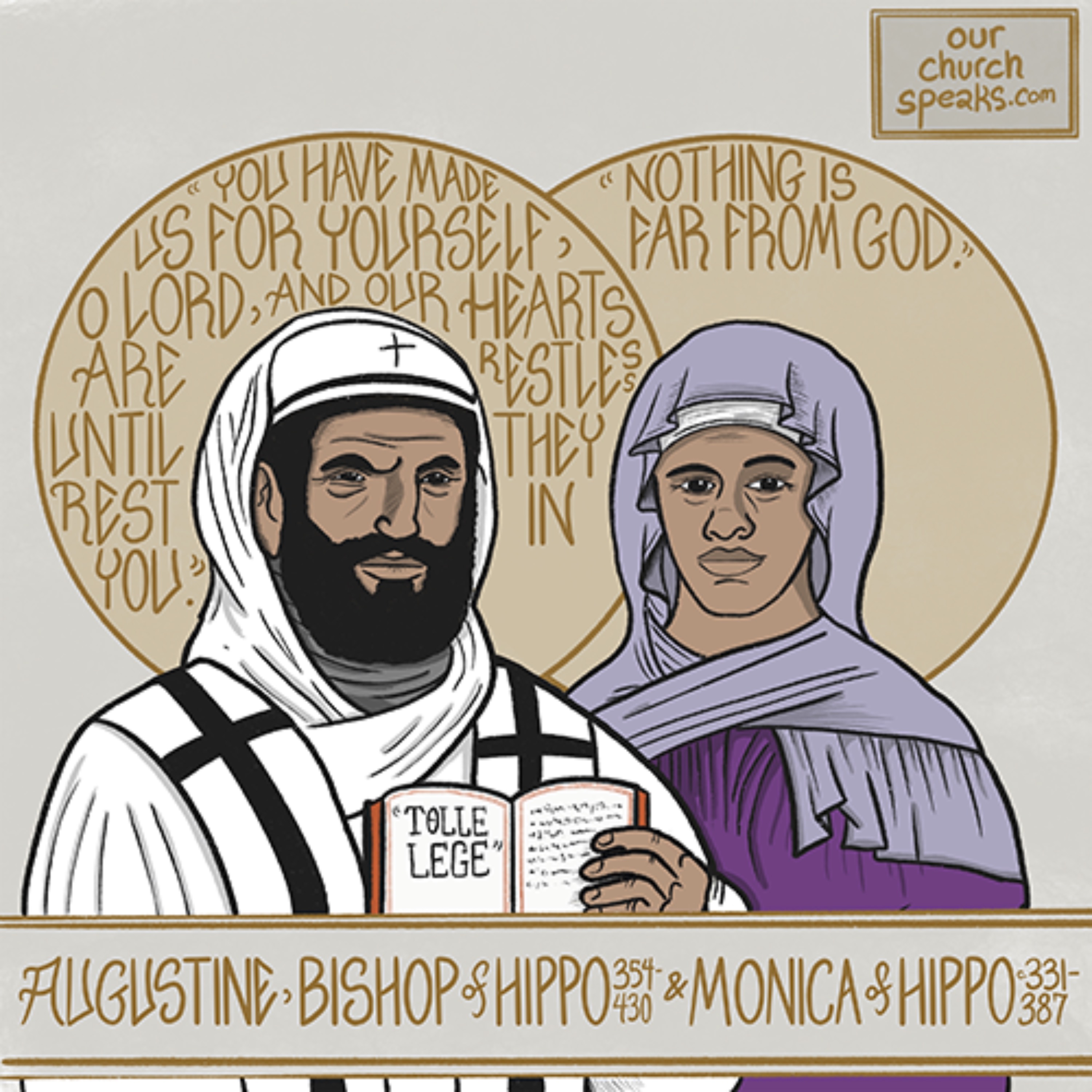
Augustine & Monica Image – from Our Church Speaks
HOME GROUP QUESTIONS
KICKOFF
Share one way you’ve noticed yourself becoming like your parents (good or bad!). What does this reveal about the power of proximity and relationship?
What stood out to you from the sermon, and what questions did it raise?
Prayer for our time in God’s word.
SET YOUR HOPE FULLY
“Therefore, preparing your minds for action, and being sober-minded, set your hope fully on the grace that will be brought to you at the revelation of Jesus Christ.” (1 Peter 1:13 ESV)
In response to all that Peter has said about what God has done for us in and through Christ Jesus — his life, his death, his resurrection, our new identity in him from 1:1-12 — we are commanded to “set our hope fully”. This involves rolling up our sleeves and seeing the practical difference that hope makes in our lives. The following four sections show this difference
HOPE LEADS TO HOLINESS
Read 1 Peter 1:14-16
- What do you notice about the two-part structure of these verses—what we’re called to turn away from AND what we’re called to embrace?
- We’re not pursuing holiness to become God’s children—we’re pursuing it as obedient children (v14). How does knowing you’re already God’s child change the way you pursue holiness?
HOPE LEADS TO WORSHIP
Read 1 Peter 1:17-21
- How does understanding that you were “ransomed with the precious blood of Christ” (not silver or gold) affect your worship?
- The sermon said: “We all worship someone or something. The only question is who or what?” What competes for your worship in daily life—money, comfort, success, relationships?
HOPE LEADS TO LOVE
Read 1 Peter 1:22-25
- Love is described as “sincere,” “brotherly,” and “earnest.” Which aspect do you find most challenging, and why?
- The sermon mentioned love has two sides: showing love AND being willing to receive it. Which is harder for you personally? Why?
HOPE LEADS TO MATURITY
Read 1 Peter 2:1-3
- What does it look like to “long for pure spiritual milk” like a newborn infant?
- What obstacles keep you from regularly feeding on Scripture? What’s one practical step you could take this week?
Prayer: In response to the passage.
Vision Prayer: Father God, by your grace, enable our church to be a city of refuge within the city of Brisbane. Empower me this week, by your Spirit, to offer one person the refuge, security, and hope found in Christ Jesus. Amen.